

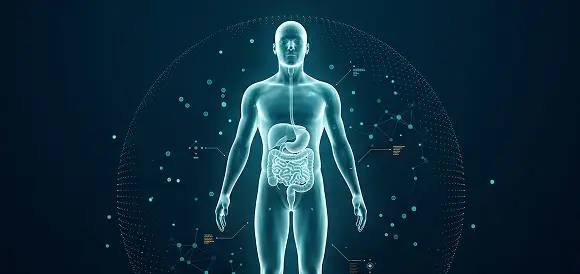
What is a Digital Twin? And How Does Enbiosis Use It in Nutrition Science?
The term ‘digital twin’ has been used in engineering and manufacturing for years. However, it is now appearing in a very different context: the science of nutrition and gut health. So, what exactly is a digital twin and why is it important for the design of nutraceuticals?
A Virtual Replica of The Real Thing
A digital twin is a virtual copy of something in the real world. This concept first emerged in the aerospace and engineering industries. Before building a new aircraft engine, for example, a digital copy is created and tested under thousands of different conditions. Any problems are identified and resolved virtually before anything is manufactured in the real world.
Over time, the applications have expanded considerably. City planners use digital twins to model traffic flow before building new roads. Energy companies simulate power grids to anticipate failures before they occur. In healthcare, digital twins are used to model individual patient physiology, enabling personalised treatment plans to be created based on real-time data and predictive analytics.
Digital twins are particularly powerful because they can handle complexity. They involve multiple interacting variables that are difficult to predict. A digital twin captures this complexity in a virtual environment, enabling thousands of scenarios to be tested before any real-world decisions are made.
At Enbiosis, we apply this technology to one of the most complex biological systems in the human body: the gut microbiome.
The Digital Twin of Your Gut Microbiome
The gut microbiome is home to trillions of microorganisms. They interact with each other, respond to what you eat and produce compounds that influence your health far beyond digestion.
No two gut microbiomes are the same. What works for one person may have no effect on another simply because their microbial communities processing those inputs are different. We know that most known health conditions are linked to the gut microbiome. The gut microbiome responds differently to each health condition and produces different compounds.
This individuality and complexity is exactly what the digital twin approach is designed to handle. Traditional formulation methods are based on averages. A digital twin, however, is built around real variation.
At Enbiosis, we create virtual models of the gut microbiome using genome-scale metabolic models of gut bacteria. This model simulates how a specific microbial community responds to different nutritional inputs. By running these simulations across thousands of real human microbiome profiles, we can test the behaviour of different combinations of food-grade ingredients before selecting a single ingredient for a formulation.
From Simulation to Formulation
The digital twin is the starting point, but it cannot work alone.
Once the simulations have identified which compounds the gut microbiome is not producing in sufficient quantities for a specific health condition, the next question is simple: how do we get them there?
Most formulations start with ingredients. A company selects something that appears promising, tests it and hopes it is effective. We do the opposite.
First, we build a virtual model of the gut microbiome. Then we identify which compounds the body needs more of and work backwards to find food-grade ingredients that gut bacteria can naturally convert into them. We call this the retrosynthesis engine. Rather than starting with an ingredient and testing its effects, it identifies the biological target and works backwards to the food-grade inputs that can support it.
Every ingredient in the final formulation has a specific, predicted role. Nothing is selected by assumption. The formulation has a clear scientific rationale before any clinical testing begins.
Why This Matters
Digital twin technology is still a relatively new concept in the fields of healthcare and nutrition. However, its potential is significant.
The ability to test thousands of scenarios in a virtual environment before making real-world decisions transforms the way complex problems are approached. In medicine, for example, it enables us to understand how a patient might respond to a treatment before it is administered. In nutrition, it means anticipating how the gut microbiome will process an ingredient.
As the technology matures, its applications will only expand. Researchers are already exploring the use of digital twins in drug discovery, personalised medicine, and disease prevention. The gut microbiome, with its complexity and influence on many areas of health, is one of the most promising areas for this approach.
At Enbiosis, we are already doing so. The digital twin is not just a future ambition for us. It is how we design every formulation today.
References
Tao, F., Xiao, B., Qi, Q., Cheng, J., & Ji, P. (2022). Digital twin modeling. Journal of Manufacturing Systems, 64, 372–389.
Vallée, A. (2023). Digital twin for healthcare systems. Frontiers in Digital Health, 5, 1253050.
Crespi, N., Drobot, A. T., & Minerva, R. (2023). The digital twin: What and why? In The Digital Twin (pp. 3–20). Cham: Springer International Publishing.
Görtz, M. (2026). Digital twins: past, present and future. Scientific Reports, 16(1), 10510.
Salvadori, M., & Rosso, G. (2024). Update on the gut microbiome in health and diseases. World Journal of Methodology, 14(1), 89196.
De Vos, W. M., Tilg, H., Van Hul, M., & Cani, P. D. (2022). Gut microbiome and health: mechanistic insights. Gut, 71(5), 1020–1032.